
 Documentation
Node reference / Skeletal controls
Look At
Turn one bone so that its configured local forward axis points toward a target.
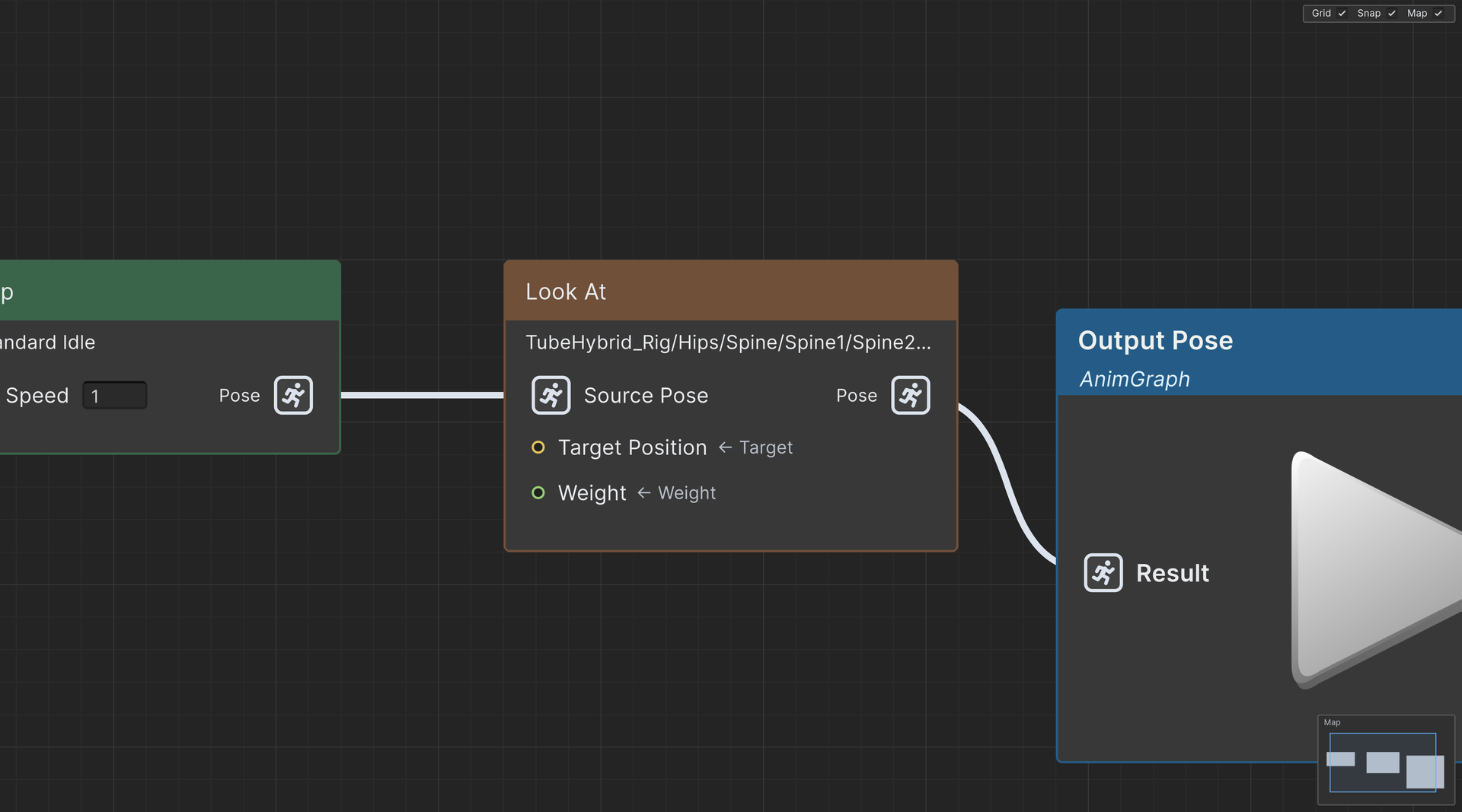
How it works
The node calculates a rotation from the current forward direction to the target direction. Max Angle Degrees limits the turn from the input pose.
Smoothing applies an exponential response to the correction. A value of 0 applies the correction at once. Positive values are a time constant in seconds.
The correction is stored relative to the parent frame so that character movement does not carry an old world-space correction.
Inputs and output
| Port | Type | Function |
|---|---|---|
| Source | Ordinary pose | The input pose to change. |
| Weight | Float | Blend the control result with the source. The default is 1. |
| Target Position | Vector3 | Default is one component unit along the incoming configured forward axis. |
| Pose | Output | The pose with the bone rotation changed. |
Settings
| Setting | Default | Function |
|---|---|---|
| Bone | Unassigned | The bone to turn. |
| Input space | Component | Select the frame for the target input. |
| Forward Axis | (0, 0, 1) | A nonzero finite axis in the local frame of the bone. |
| Max Angle Degrees | 180 | Maximum turn from the input pose. Valid range: 0 to 180 degrees. |
| Smoothing | 0 seconds | A finite, nonnegative response time constant. |
| Weight | 1 | Control influence, clamped to 0 to 1. |
| LOD Threshold | Disabled | Above the selected level, pass the source through and keep control state. |
Common node controls
Name changes the canvas label. Type identifies the node and is read-only. Advanced shows structural pose connections and retained data.
Scalar input rows can use a stored constant or a compatible connected source. Use Show as Pin where available to show an optional input on the card. The selected source supplies the value.
Preview model selects the model used to resolve bone choices in the picker. Bone references can identify Humanoid roles or transform paths. The picker does not replace the graph character model.
Control input sources
| Setting | Function |
|---|---|
| Default | Use the incoming-pose value described for the input. Offsets use zero or identity defaults. |
| Constant | Use the typed value stored on the node. Rotation fields show Yaw, Pitch and Roll in degrees and store a quaternion. |
| Variable | Read a compatible input binding. |
| Inactive inputs | Changing a mode retains inactive settings. Only the active inputs affect the control. |
Input spaces
| Setting | Function |
|---|---|
| Parent Bone | Use the parent frame of the input space bone. |
| Bone | Use the frame of the input space bone itself. |
| Component | Use the prepared skeleton model frame. |
| World | Use the scene frame, including the current character transform and scale. |
| Space Bone | Select another frame bone for Bone or Parent Bone space. If none is selected, use the input default frame bone. |
| World-stage evaluation | A built-in control with an active World input runs after root motion and motor movement. The Editor reports this requirement. |
Level of detail
| Setting | Function |
|---|---|
| Disabled | Apply no node threshold. |
| Enabled | Run the node when the character LOD level is at or below the selected level. Level 0 is a valid enabled threshold. |
| Above the threshold | Use the pass-through behavior stated for this node. LOD changes do not replace the node input requirements. |
Setup example
- Connect Source and choose the head or another bone.
- Set Forward Axis to the direction that points forward on that bone.
- Set the target source and frame. Adjust the angle limit, smoothing and weight.
Try it in Gallery
Open 24 Look At in the Gallery Graphs folder. Change Target and see how the selected bone turns.
Requirements and limits
- The bone and its ancestors require positive uniform scale.
- This node turns one bone. It does not distribute rotation over a spine chain.
- The optional sample Look At uses a different algorithm based on the character forward axis.
Editor guides
Reference details
BAS 1.0 reference. Node type: LookAtNode. Main source: BuiltinSkeletalControls.cs. Defaults also use the node constructor and the shared Editor field definitions.